Market Insights - 8/3/26
Observations & Insights – August 3, 2026
Markets Rally on Earnings
Strong earnings results lifted the three major U.S. stock indexes to gains of 1% to nearly 2%, largely offsetting the previous week’s modest declines. Despite the rebound, the S&P 500, the NASDAQ, and the Dow remained below the record levels they set over the past two months.
Key Points
- Markets rallied last week but remain well off their highs.
- US GDP slowed to a 1.5% annual rate.
- The Fed left interest rates unchanged, 3 of 5 members dissented.
- Earnings estimates rose again after the latest round of reports from tech companies.
Observations: Fed Dissents, Bond Yields Surge
U.S. stock indexes fell sharply on Wednesday, and medium- to long-term government bond yields surged in the wake of a U.S. Federal Reserve meeting and Chair Kevin Warsh’s news conference. While the Fed kept its benchmark lending rate unchanged, three of the Fed’s voting members dissented, preferring to lift rates.
Concerns about long-term inflationary pressures boosted the yield of the 30-year U.S. Treasury above 5.20% on Wednesday afternoon, near its highest level since 2007. By Friday afternoon, the 30-year yield climbed further to 5.25% and the 10-year yield rose to 4.71%, the highest in more than a year and a half.
Earnings forecasts were sharply raised as the largest technology companies reported quarterly results and nearly two-thirds of S&P 500 companies had released their second- quarter numbers. As of Friday, analysts projected that earnings for S&P 500 companies rose an average 47.4% in the second quarter, up from a 38.0% forecast at the end of the previous week, according to FactSet. If the 47.4% gain holds up by the time earnings season concludes, it will mark the strongest quarterly growth rate in five years.
U.S. GDP slowed to an annual growth rate of 1.5% in this year’s second quarter as momentum slipped in the wake of the preceding quarter’s 2.1% result. The government’s initial second-quarter estimate came in lower than most economists had forecast. While the consumer spending component of GDP posted a gain, federal government spending and inventories lagged.
The U.S. Federal Reserve’s preferred inflation gauge showed price pressures moderating somewhat in June after climbing in the preceding month to the highest level in more than three years. Thursday’s Personal Consumer Expenditures Price Index report recorded an annual rate of 3.7% in June after reaching 4.1% in May. Excluding food and energy prices, June’s core PCE inflation was 3.3%.
July marked the second slightly negative month in a row for the S&P 500, which slipped 0.1% for the month. The NASDAQ sustained a bigger decline of 3.2%. In contrast, the Dow added 0.3% in July, marking that index’s fourth positive month in a row.
A labor market report due out on Friday will show whether June’s jobs growth slowdown extended into July. In June, job growth fell short of economists’ consensus expectations, marking a shift after gains exceeded consensus forecasts in the preceding three months. The economy generated 57,000 new jobs, roughly half the total that had been expected and initial estimates of gains in April and May were revised downward.
Insights: In Defense of Capitalism
Capitalism on Trial
Capitalism seems to be on trial lately. Polls consistently show that many younger Americans have a more favorable view of democratic socialism and greater government involvement in the economy than previous generations. Rising housing costs, student debt, healthcare expenses, and growing wealth inequality have led many to question whether free markets are still working. These concerns are understandable. For many young Americans, buying a home feels increasingly out of reach, the cost of higher education has soared, and the American Dream can seem more elusive than it once did. These frustrations are real, and they deserve thoughtful discussion. But before we abandon the economic system that has shaped the modern world, it is worth asking a simple question: Compared to what?
Imperfect, But Better Than the Alternatives
Capitalism is far from perfect. It produces recessions, market corrections, income inequality, and at times rewards excessive risk-taking. Businesses fail, industries are disrupted, and markets can be driven by fear and greed just as often as logic. Left unchecked, capitalism can also produce monopolies and corporate excess. No honest observer would argue otherwise. Yet the true measure of any economic system is not whether it is flawless, but whether it consistently delivers better outcomes than the available alternatives. History suggests that free-market capitalism, while imperfect, has done exactly that.
History Is the Ultimate Scorecard
If you only look at one chart in this newsletter, make it this one.
Source: World Bank
Statistics often fail to capture the magnitude of human progress. This chart tells the story better than I can. For nearly all of human history, extreme poverty was the normal condition. Around 1800, roughly 85% of the world's population lived in extreme poverty, surviving on the equivalent of less than $2 per day in today's dollars. By 1966, that figure had fallen to roughly 50%. Today, it is less than 10%. While many factors contributed to this extraordinary improvement, including advances in medicine, education, sanitation, and technology, none would have been possible without decades of economic growth fueled by trade, investment, entrepreneurship, and the expansion of market economies.
Perhaps the greatest economic story of the past century is one that rarely makes headlines. Over the last several decades, more than a billion people have escaped extreme poverty. Countries that embraced property rights, entrepreneurship, private investment, and freer markets experienced dramatic improvements in living standards, while nations that relied heavily on centralized economic planning generally struggled with slower growth, shortages, inflation, and declining productivity.
China's extraordinary reduction in poverty accelerated only after it began introducing market reforms. South Korea transformed itself from one of the world's poorest countries into a global leader in technology and manufacturing.
By contrast, the Soviet Union ultimately collapsed under the weight of its centrally planned economy, and more recently Venezuela has provided another sobering reminder that price controls, nationalization, and government-directed markets often produce shortages rather than prosperity.
Markets Reward Solving Problems
The reason is simple. Capitalism rewards people and businesses for solving problems. Entrepreneurs do not become successful because governments declare them successful. They earn that success when millions of consumers voluntarily choose their products or services over competing alternatives.
Apple transformed personal technology. Amazon fundamentally changed retail and logistics. NVIDIA has become one of the world's most valuable companies because it provides the computing power behind today's artificial intelligence revolution. Pharmaceutical companies have developed treatments that have extended and improved countless lives.
None of these innovations came from government committees deciding which ideas deserved to succeed. They emerged because individuals took enormous financial risks in pursuit of better solutions to real-world problems.
Wealth Is Created, Not Redistributed
One of the most misunderstood aspects of capitalism is the belief that wealth is fixed, that if one person becomes extraordinarily wealthy, someone else must necessarily become poorer. In reality, wealth is constantly being created.
A century ago, there were no software companies, no biotechnology firms, no cloud computing, no streaming services, and certainly no artificial intelligence industry. These sectors have generated trillions of dollars of entirely new economic value while creating millions of jobs and improving productivity across nearly every industry.
Economies are not a fixed pie to be divided differently; they are capable of growing as innovation expands opportunity and creates value that simply did not exist before.
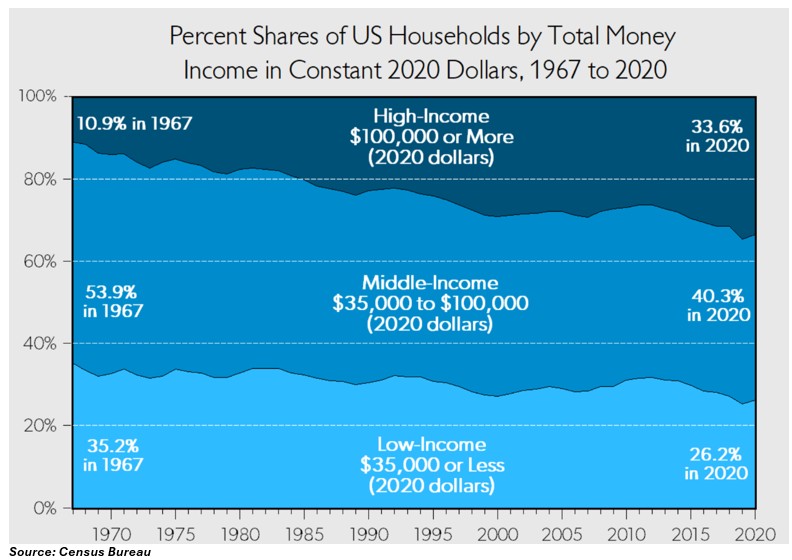
One criticism often leveled against capitalism is that it has "destroyed the middle class." While the middle-income share of U.S. households has indeed declined over the past half century, this chart tells a more complete story. In 1967, just 10.9% of households earned the equivalent of more than $100,000 in today's dollars. By 2020, that figure had more than tripled to 33.6%. Meanwhile, the share of low-income households fell from 35.2% to 26.2%. In other words, much of the shrinking middle class didn't fall into poverty, it moved up the income ladder. That does not mean every family has prospered equally, nor does it dismiss the affordability challenges many households face today. But it is an important reminder that economic progress should be measured not only by inequality, but also by whether more people are achieving higher standards of living over time.
For long-term investors, this is exactly what we would expect to see in a growing capitalist economy, businesses create value, productivity rises, wages trend higher over time, and more households move into higher income brackets.
The Quiet Miracle of Everyday Life
Perhaps capitalism's greatest success is so commonplace that we barely notice it anymore. Consider the quality of life enjoyed by the average American today. Instant communication with anyone in the world. Medical treatments that were unimaginable only a generation ago. Air conditioning, affordable automobiles, commercial air travel, unlimited access to information, and entertainment that fits in your pocket. These conveniences were once luxuries available only to the wealthy, or they simply did not exist. Competition, innovation, and productivity steadily reduced costs while improving quality, allowing millions of people to enjoy standards of living that previous generations could scarcely imagine.
Capitalism Requires Rules
Defending capitalism does not mean defending every corporation or every market outcome. Healthy markets require strong institutions. Property rights, the rule of law, independent courts, transparent financial markets, and reasonable regulation are essential for capitalism to function properly. Free markets are at their best when competition flourishes and no single company or government has the power to distort outcomes. The answer to capitalism's shortcomings is not abandoning markets altogether but improving the institutions that allow markets to operate fairly and efficiently.
Why This Matters for Investors
For investors, this discussion is more than an academic exercise. Every time we purchase shares of a company, we become partial owners of businesses that create products, solve problems, employ millions of people, and drive economic progress. We are not simply buying ticker symbols; we are investing in innovation, productivity, and the ingenuity of people striving to make life better. That is why, despite recessions, market corrections, elections, and geopolitical uncertainty, equities have historically been one of the most effective tools for building long-term wealth.
Final Thoughts
Capitalism does not promise equal outcomes. It promises equal opportunity to compete, innovate, and create. It has flaws that deserve thoughtful reform, but history suggests those flaws are better addressed by improving markets than replacing them. For investors, this distinction matters. Long-term wealth has always been created by owning productive businesses that improve people's lives. That is why, despite recessions, elections, and headlines, we continue to believe that disciplined ownership of great companies remains one of the most powerful wealth-building tools ever created.
It is our aim at Asbury Wealth Partners that you find the market commentary we provide informative and useful. As our success grows mainly through referrals from our clients, we encourage you to share this weekly newsletter with your friends, family, and colleagues. If you are a client, we thank you for your business and your confidence. If you are not yet a client, we encourage you to contact us today and explore how our team may be able to add value to your unique financial situation.
Thank You,
Jeff
~~~~~~~~~~~~~~~~~~~~~~~
Jeffrey S. Markewich
Wealth Advisor
Off – 719-548-8103
Cell - 719-357-7747
Text – 702-493-9678
TF - 888-328-7655
~~~~~~~~~~~~~~~~~~~~~~~
An Introduction to Your Friends & Family
is the Greatest Compliment You Can Give
Jeffrey Markewich is a Registered Representative with, and securities and advisory services offered through LPL Financial, a registered investment advisor, Member FINRA/SIPC.
The information contained in this email message is being transmitted to and is intended for the use of only the individual(s) to whom it is addressed. If the reader
of this message is not the intended recipient, you are hereby advised that any dissemination, distribution or copying of this message is strictly prohibited. If you have received this message in error, please reply and you will be removed.
These views are those of the author, not of the broker-dealer or its affiliates. This material contains an assessment of the market and economic environment at a specific point in time and is not intended to be a forecast of future events, or a guarantee of future results. All investments involve risk, including loss of principal. Forward-looking statements are subject to certain risks and uncertainties. Actual results, performance, or achievements may differ materially from those expressed or implied. Information is based on data gathered from what we believe are reliable sources.
The opinions voiced in this material are for general information only and are not intended to provide specific advice or recommendations for any individual. All performance referenced is historical and is no guarantee of future results. All indices are unmanaged and may not be invested into directly.
The NASDAQ Composite Index measures all NASDAQ domestic and non-U.S. based common stocks listed on The NASDAQ Stock Market. The market value, the last sale price multiplied by total shares outstanding, is calculated throughout the trading day, and is related to the total value of the Index.
S&P 500 – A capitalization-weighted index of 500 stocks designed to measure performance of the broad domestic economy through changes in the aggregate market value of 500 stocks representing all major industries.
The Dow Jones Industrial Average is comprised of 30 stocks that are major factors in their industries and widely held by individuals and institutional investors.
The Russell 2000 Index is an unmanaged index generally representative of the 2,000 smallest companies in the Russell 3000 index, which represents approximately 10% of the total market capitalization of the Russell 3000 Index.
The CBOE Volatility Index? (VIX?) is meant to be forward looking, showing the market's expectation of 30-day volatility in either direction, and is considered by many to be a barometer of investor sentiment and market volatility, commonly referred to as “Investor Fear Gauge”.
International investing involves special risks such as currency fluctuation and political instability and may not be suitable for all investors.
All indexes referenced are unmanaged. The volatility of indexes could be materially different from that of a client’s portfolio. Unmanaged index returns do not reflect fees, expenses, or sales charges. You cannot invest directly in an index. Consult your financial professional before making any investment decision.
There is no guarantee that a diversified portfolio will enhance overall returns or outperform a non-diversified portfolio. Diversification does not protect against market risk.
Asset allocation does not ensure a profit or protect against a loss.
The Consumer Price Indexes (CPI) program produces monthly data on changes in the prices paid by urban consumers for a representative basket of goods and services (Source: U.S. Department of Labor).
The Gross Domestic Product (GDP) is a comprehensive measure of U.S. economic activity. GDP measures the value of the final goods and services produced in the United States (without double counting the intermediate goods and services used up to produce them). Changes in GDP are the most popular indicator of the nation's overall economic health.
Government bonds and Treasury bills are guaranteed by the US government as to the timely payment of principal and interest and, if held to maturity, offer a fixed rate of return and fixed principal value.
LPL Tracking # 1153664