Market Insights - 3/10/26
Market Retreats
Middle Eastern conflict, rising oil prices, and a disappointing monthly jobs report weighed on stocks, and U.S. indexes fell for the second week in a row. The Dow finished down -2.9% on a total return basis, the S&P 500 retreated -2.0%, and the NASDAQ ended -1.2% lower.
Key Points
- Rising oil prices tied to Middle East tensions are reintroducing inflation uncertainty and adding short-term volatility to financial markets.
- A weaker-than-expected jobs report suggests the labor market may be gradually cooling after several years of exceptionally strong growth.
- Higher energy costs could complicate the Federal Reserve’s path toward interest-rate cuts if inflation pressures persist.
- Despite recent volatility, strong corporate earnings and continued business investment suggest the broader economic foundation remains relatively stable.
Observations: Oil Spikes While Jobs Weaken
Escalating military conflict rippled throughout the Middle East, pushing oil prices to the highest levels since September 2023. With oil shipments in the Persian Gulf’s Strait of Hormuz sharply curtailed, U.S. crude was trading around $91 per barrel late Friday afternoon, up from $67 a week earlier. Oil is likely to move higher as this conflict continues.
February’s net loss of 92,000 jobs came as a surprise, as most economists had forecast that Friday’s report would show a gain of around 50,000. The setback marked the third monthly jobs decline over the past five months, and initial figures for December and January were revised downward by a combined 69,000 jobs.
Ex-U.S. stock indexes sustained far bigger weekly declines than their U.S. counterparts. An ex-U.S. developed-market benchmark, the MSCI EAFE Index, and an emerging-markets counterpart, the MSCI Emerging Markets Index, were both down nearly -7% for the week.
Prices of U.S. government bonds fell, sending yields higher, as rising oil prices added to recent inflationary pressures. On Friday, the yield of the 10-year Treasury closed at 4.15%, up from 3.96% the previous week, when yields had tumbled to the lowest level in more than four months.
An index that tracks investors’ expectations of short-term U.S. stock market volatility climbed on Friday to the highest level since last spring’s tariff-related surge in volatility. On Friday afternoon, the CBOE Volatility Index (VIX) closed at 29.5, up 48% from its closing level of the previous week.
Companies in the S&P 500 posted an average earnings gain of 14% over the same quarter a year earlier, according to FactSet data from the recently concluded fourth-quarter earnings season. That result marked the fifth consecutive quarter of double-digit growth. Information technology posted a 33% earnings gain, the highest among all 11 sectors.
A Consumer Price Index report scheduled for release on Wednesday and a Personal Consumption Expenditures Price Index reading due on Friday could offer some clarity about inflation trends after recently divergent results. The most recent monthly CPI report showed that inflation eased to a 2.4% annual rate, while the PCE report showed a 2.9% rate, with prices rising at the fastest pace in nearly a year.
Insights: Oil, Inflation, and the Return of Macro Uncertainty
The sharp rise in oil prices during the past week illustrates how quickly geopolitical developments can reintroduce inflation risk into the global economy. With crude oil climbing from the mid-$60s to over $90 per barrel following disruptions to shipping through the Strait of Hormuz, energy markets have suddenly become a central variable in the inflation outlook.
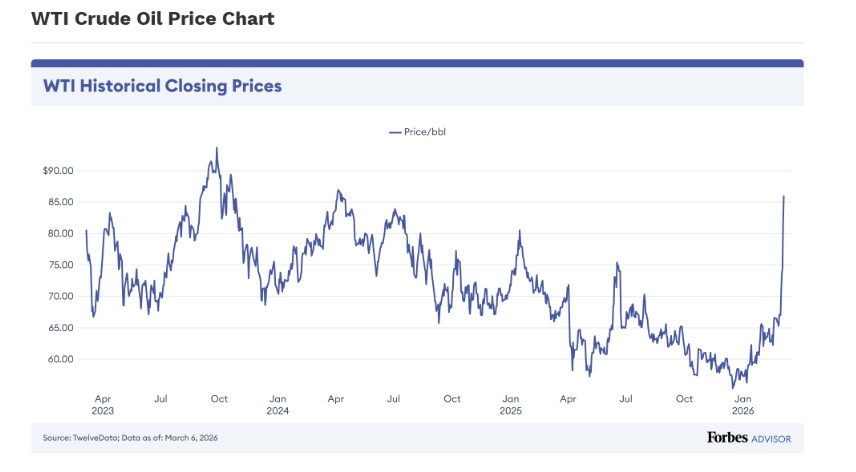
Oil price shocks matter because they ripple quickly through the broader economy. Higher energy costs raise transportation and manufacturing expenses, feed into consumer prices, and reduce household purchasing power. Even when the underlying economy remains stable, a rapid increase in oil prices can temporarily slow economic activity while simultaneously pushing inflation higher, a combination that tends to unsettle financial markets.
This dynamic also complicates the outlook for monetary policy. In recent months, markets began to price in the possibility that the Federal Reserve could begin easing interest rates later this year as economic growth slowed and inflation gradually moderated. A sustained rise in oil prices could delay that timeline by keeping headline inflation elevated, even if underlying demand pressures continue to ease. Goldman Sachs said on Friday that that if the price of oil stays over $77 per barrel for any length of time, CPI will move back over 3%.
There has been considerable discussion about whether the Federal Reserve has a policy response available for the current situation. In reality, monetary policy has limited influence over geopolitical events. Adjusting interest rates cannot resolve a military conflict, and rising energy prices tied to the war may actually make it more difficult for the Fed to lower rates in the near term. If higher oil prices feed into inflation, policymakers may be forced to remain cautious until price pressures stabilize.
Even if the conflict itself proves relatively short-lived, the economic ripple effects could persist much longer. Markets are particularly sensitive to any disruptions involving shipping routes, production facilities, or global energy supply. A useful comparison may be the aftermath of a major storm at a busy airport—once the storm passes, normal operations do not immediately resume. Flights must be rescheduled, backlogs cleared, and the system gradually reset. Global supply chains function in much the same way, meaning it could take months for markets and energy systems to fully normalize after the conflict subsides.
Bond markets appear to be adjusting to this possibility. Treasury yields moved higher during the week as investors incorporated the potential for renewed inflation pressures tied to energy prices. Higher yields also reflect a degree of uncertainty surrounding the labor market after February’s unexpected decline in payrolls.
United States 10-Year Bond Yield (1 year)
Source: Seeking Alpha
The negative jobs report introduced a second macroeconomic question: whether the recent cooling in employment represents temporary volatility or the beginning of a broader slowdown. While one month of data rarely establishes a trend, the fact that payrolls have declined in three of the past five months suggests the labor market may be gradually losing momentum after several years of exceptionally strong growth.
At the same time, corporate earnings data continues to point toward a fundamentally resilient business environment. S&P 500 companies just completed a fifth consecutive quarter of double-digit earnings growth, led by particularly strong results in the technology sector. That strength suggests that while economic growth may be moderating, corporate profitability remains supported by healthy balance sheets, stable consumer spending, and continued investment in productivity-enhancing technologies.
Taken together, the current market environment reflects a shift away from the relatively stable conditions investors enjoyed last year. Instead, markets are once again balancing multiple macroeconomic forces simultaneously, geopolitical risk, inflation uncertainty, evolving labor market conditions, and the timing of future Federal Reserve policy changes.
The S&P 500 fell 2% last week, leaving it down 1.3% for the year. While we would rather see the index positive, that is not a meaningful decline. February into March has typically seen seasonal challenges historically. In fact, over the past 20 years, the index bottom has taken place in mid-March on average. Of course, we know that the conflict in the Middle East is the driver of this decline rather than just the calendar, but the calendar can still play a role, after settling into the new year post-holiday season, February and March can be a time when stuff happens.
Periods like this often produce higher volatility as investors reassess expectations for growth, inflation, and interest rates. However, volatility itself is not unusual when the market transitions between phases of the economic cycle.
For now, the most important variables to watch are the trajectory of oil prices, upcoming inflation data, and whether labor market softness persists in future reports. If energy prices stabilize and employment remains broadly intact, the economy may continue to grow at a slower but still positive pace. If energy-driven inflation pressures intensify, markets may need to adjust expectations for interest rates and economic growth.
Final Thoughts
Financial markets are once again being reminded that economic cycles are rarely shaped by a single variable. Rising oil prices, softer employment data, and mixed inflation signals have reintroduced a level of uncertainty that investors had largely moved past during much of last year. The sharp increase in crude prices highlights how quickly geopolitical developments can influence inflation expectations and interest-rate outlooks, while the recent jobs report raises questions about whether the labor market is beginning to cool more meaningfully after several years of exceptional strength.
Despite these developments, the broader economic foundation remains relatively stable. Corporate earnings continue to grow, household balance sheets remain generally healthy, and business investment, particularly in technology and productivity-enhancing infrastructure, continues to support long-term economic capacity. Periods of higher volatility often occur when markets transition between phases of the economic cycle, as investors reassess growth, inflation, and policy expectations. While near-term uncertainty may persist, maintaining a disciplined, long-term investment perspective remains the most effective approach in environments where markets are responding to shifting macroeconomic forces rather than a clear deterioration in underlying fundamentals.
It is our aim at Asbury Wealth Partners that you find the market commentary we provide informative and useful. As our success grows mainly through referrals from our clients, we encourage you to share this weekly newsletter with your friends, family, and colleagues. If you are a client, we thank you for your business and your confidence. If you are not yet a client, we encourage you to contact us today and explore how our team may be able to add value to your unique financial situation.
Thank You,
Jeff
~~~~~~~~~~~~~~~~~~~~~~~
Jeffrey S. Markewich
Wealth Advisor
Off – 719-548-8103
Cell - 719-357-7747
Text – 702-493-9678
TF - 888-328-7655
~~~~~~~~~~~~~~~~~~~~~~~
An Introduction to Your Friends & Family
is the Greatest Compliment You Can Give
Jeffrey Markewich is a Registered Representative with, and securities and advisory services offered through LPL Financial, a registered investment advisor, Member FINRA/SIPC.
The information contained in this email message is being transmitted to and is intended for the use of only the individual(s) to whom it is addressed. If the reader
of this message is not the intended recipient, you are hereby advised that any dissemination, distribution or copying of this message is strictly prohibited. If you have received this message in error, please reply and you will be removed.
These views are those of the author, not of the broker-dealer or its affiliates. This material contains an assessment of the market and economic environment at a specific point in time and is not intended to be a forecast of future events, or a guarantee of future results. All investments involve risk, including loss of principal. Forward-looking statements are subject to certain risks and uncertainties. Actual results, performance, or achievements may differ materially from those expressed or implied. Information is based on data gathered from what we believe are reliable sources.
The NASDAQ Composite Index measures all NASDAQ domestic and non-U.S. based common stocks listed on The NASDAQ Stock Market. The market value, the last sale price multiplied by total shares outstanding, is calculated throughout the trading day, and is related to the total value of the Index.
S&P 500 – A capitalization-weighted index of 500 stocks designed to measure performance of the broad domestic economy through changes in the aggregate market value of 500 stocks representing all major industries.
The Dow Jones Industrial Average is comprised of 30 stocks that are major factors in their industries and widely held by individuals and institutional investors.
The Russell 2000 Index is an unmanaged index generally representative of the 2,000 smallest companies in the Russell 3000 index, which represents approximately 10% of the total market capitalization of the Russell 3000 Index.
The CBOE Volatility Index? (VIX?) is meant to be forward looking, showing the market's expectation of 30-day volatility in either direction, and is considered by many to be a barometer of investor sentiment and market volatility, commonly referred to as “Investor Fear Gauge”.
International investing involves special risks such as currency fluctuation and political instability and may not be suitable for all investors.
All indexes referenced are unmanaged. The volatility of indexes could be materially different from that of a client’s portfolio. Unmanaged index returns do not reflect fees, expenses, or sales charges. You cannot invest directly in an index. Consult your financial professional before making any investment decision.
There is no guarantee that a diversified portfolio will enhance overall returns or outperform a non-diversified portfolio. Diversification does not protect against market risk.
Asset allocation does not ensure a profit or protect against a loss.
The Consumer Price Indexes (CPI) program produces monthly data on changes in the prices paid by urban consumers for a representative basket of goods and services (Source: U.S. Department of Labor).
The Gross Domestic Product (GDP) is a comprehensive measure of U.S. economic activity. GDP measures the value of the final goods and services produced in the United States (without double counting the intermediate goods and services used up to produce them). Changes in GDP are the most popular indicator of the nation's overall economic health.
Government bonds and Treasury bills are guaranteed by the US government as to the timely payment of principal and interest and, if held to maturity, offer a fixed rate of return and fixed principal value.
LPL Tracking #1076057